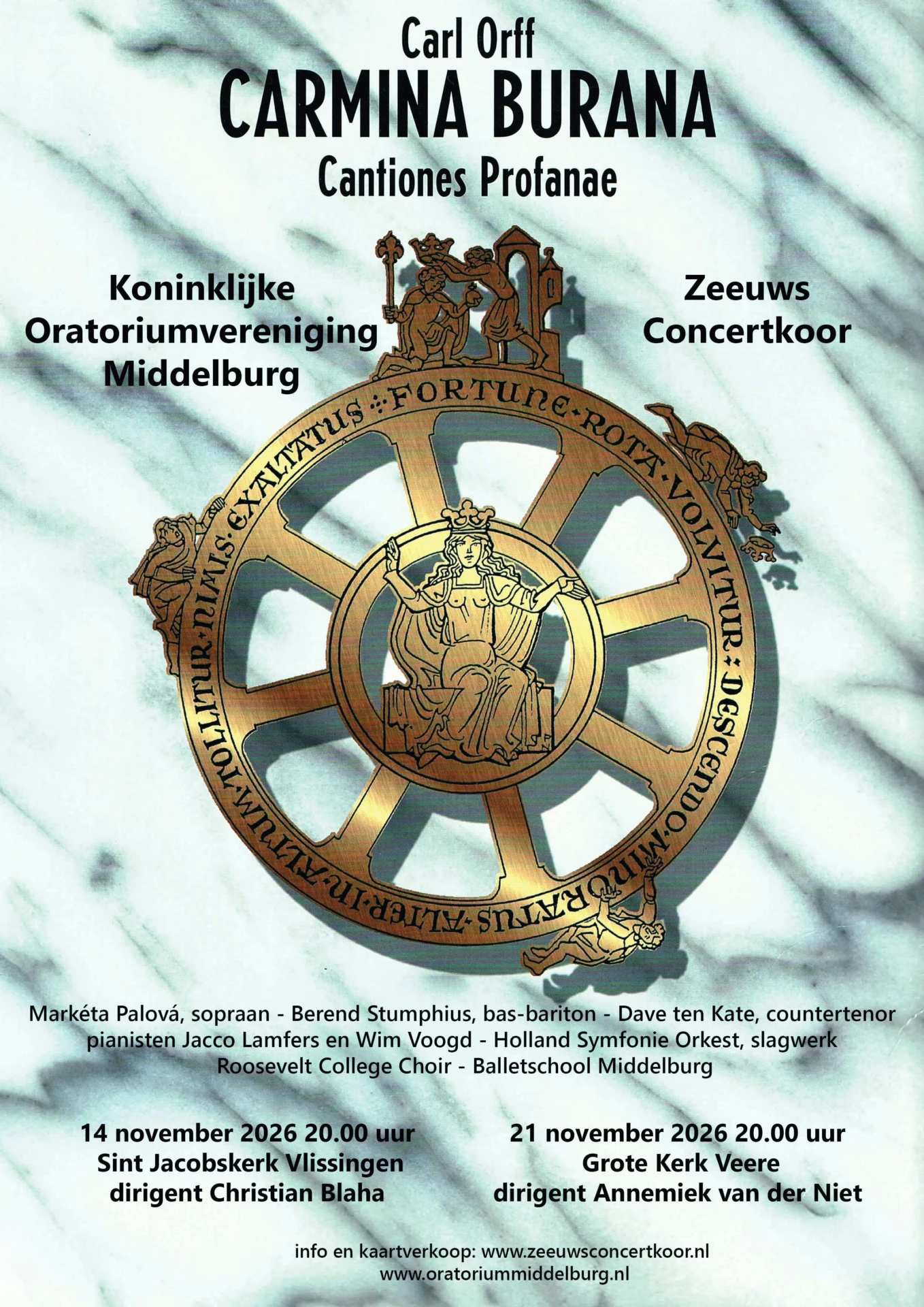
The texts of the Carmina Burana are based on a medieval collection of poems about love, drink, and fate. Carl Orff gave these centuries-old texts a strikingly direct and rhythmic musical style, making the work still accessible and popular today.
The opening choir O Fortuna is undoubtedly the most famous part of Carmina Burana. With its threatening sound and powerful build-up, it depicts the capriciousness of fate. The piece is widely used in films, trailers, and advertisements, contributing to its global popularity.
With large choirs, lots of percussion and strong, repetitive melodies, Orff creates an intense listening experience. Carmina Burana is not complicated music; it’s music that you immediately feel and that appeals to a wide audience.
With the music of Carmina Burana, Orff made an attempt to rediscover the original form of the theater. He described his composition as ‘worldly songs for soloists and choir, accompanied by instruments and magical images.’.
Several scenes unfold on the stage: choirs, dancing, drinking songs, declarations of love – almost all of them with a simple melody and a catchy rhythm. The songs – usually written by clerics who wandered around as freelance artists – glorify the present, the here and now. Dancers from the Balletschool Middelburg bring these images to life with their dance.
There are two versions of the Carmina Burana:
- - the full orchestral version: this is the famous, grand performance for a large symphony orchestra, a large choir, a children's choir and three soloists (soprano, tenor and baritone); ;
- - the chamber version, with two pianos and percussion, arranged in 1956 by Wilhelm Killmayer on commission from Carl Orff himself. In this version, the entire orchestra is replaced by two pianos and an extended percussion group, while the choir and solo parts remain identical. This version sounds more transparent and emphasizes the rhythmic power.
The Zeeuws Concertkoor will perform the chamber version together with the Royal Oratorio Vereniging Middelburg (KOV) on November 14. The Roosevelt College Choir from Middelburg will also be participating.
The following artists are also participating in this concert: soloists Markéta Palová, soprano, Berend Stumphius, bass-baritone, and Dave ten Kate, countertenor, pianists Jacco Lamfers and Wim Voogd, Holland Symphony Orchestra, timpani and percussion. The entire ensemble is conducted by conductor Christian Blaha.